We were going through the priority keywords with a landscaper client when he brought one up: "concrete driveways." The trouble was, he doesn't pour concrete. He does turf, retaining walls and garden design, and he does them well. None of it is concrete.
A different client asked us to get him showing up for a competitor's business name. Lovely bloke, genuinely good at his trade, certain that if we could just plant the right words in the right places, Google would slot him in above the businesses already sitting in the Top 3.
Both come from the same honest idea about how keywords work. Find a search term with good volume, put it in your business name, your services and your website, sprinkle it through a few reviews, and Google rewards you with a ranking. Keywords in, ranking out.
It is a reasonable guess, because that is roughly how search worked fifteen years ago. On Google Maps it never really worked that way, and the AI search era has only made the gap clearer.
Why we can't put a donut sign on a bakery that has no donuts
This is the picture we use with clients, because it lands quickly. Imagine hanging a big donut sign on a bakery that doesn't sell donuts. Customers walk in expecting donuts, and there are none. Everyone leaves unhappy, and the bakery looks worse for it.
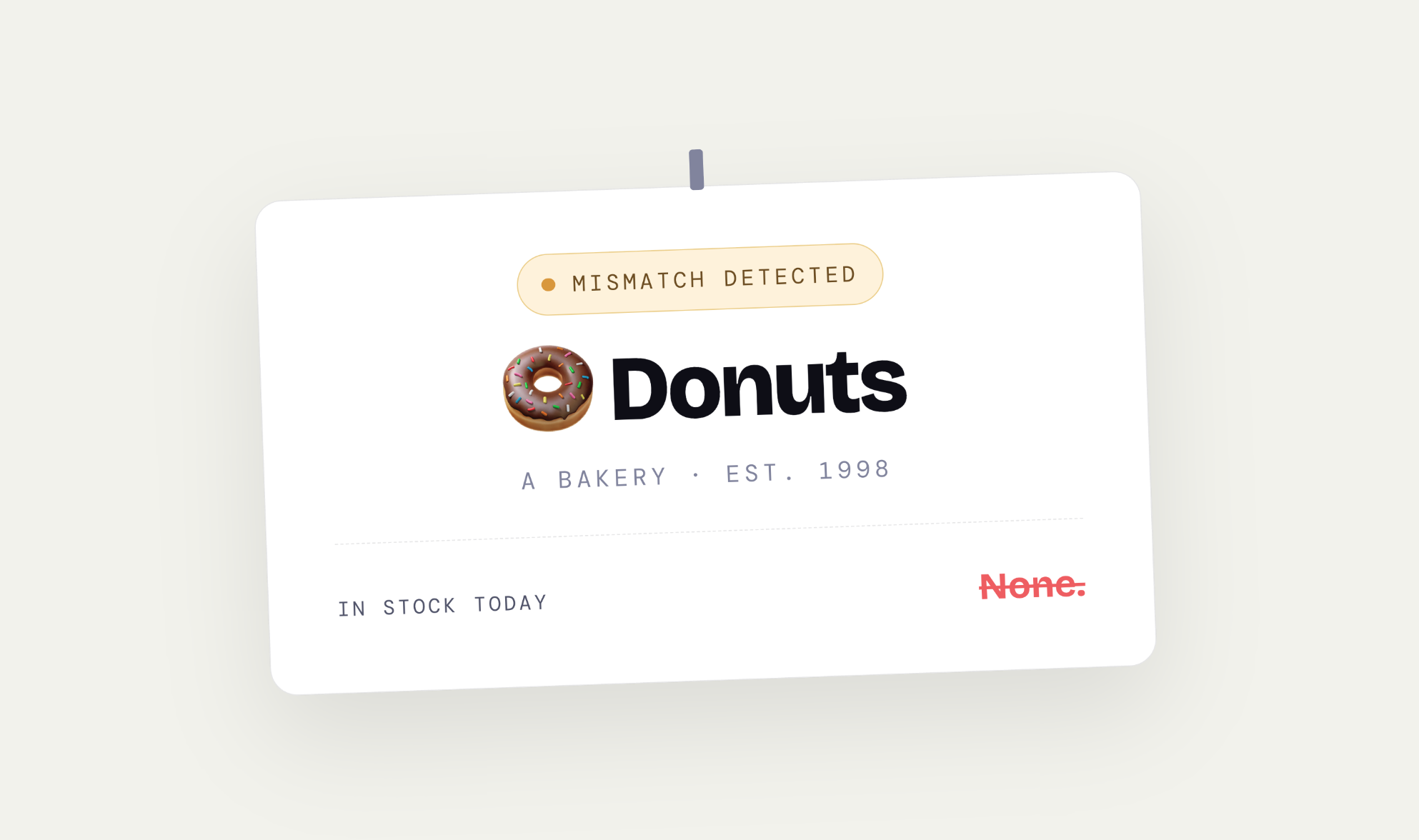
Google's organic ranking works the same way. It reads your Google Business Profile and your website to understand what your business actually is, then matches that to what people search for. When the match is genuine, you become eligible to appear. When it isn't there, Google ranks the businesses where it is, because its whole job is to avoid sending someone to a bakery with no donuts.
So when our landscaper asks to rank for "concrete driveways," nothing in his profile, his services or his reviews tells Google he pours concrete, for the straightforward reason that he doesn't. Google has no honest match to make. No keyword fixes that. He can start offering concrete and describe it properly, or he can put that energy into ranking for the work he already does, where the match is real and the leads are the right ones.
Why a competitor's keyword is off the table too
The competitor request fails for a related reason. When someone types a rival's business name into Google, they have already decided who they want. They are not browsing the category. They are looking for one specific business, by name.
Google's local results are built to connect that searcher with the business that genuinely fits, and a competitor's name points at the competitor, not at you. Paid ads are a different game: you can bid on almost any term, a rival's name included, and Google takes the money regardless of fit. Organic Maps positions reward alignment between what you are and what people actually search for. You earn that position rather than rent it, and it compounds in a way an ad never can.
There is a fair version of this request, though. If you mean the searches a competitor ranks for, the category and service terms rather than their name, that is exactly the game worth playing. "Removalist Newcastle" is fair game. "Acme Removals," their actual business name, is not.
So, are keywords dead?
No. The headline gets written every time search changes, and it is wrong again this time. What has changed is the job keywords do.
They are no longer a lever you pull to force a position. They are how Google, and now AI tools, understand what your business is and which searches you genuinely belong in. Google's own documentation names three things behind local results: relevance, distance and prominence. Keywords feed relevance. Your primary category, the services you list, the content on your website and the language real customers use in their reviews all tell Google which searches fit you.
It helps to see where that sits. Whitespark's 2026 Local Search Ranking Factors report, the longest-running survey of local SEO specialists, puts the heaviest weight on a few categories:
- Google Business Profile signals: 32%. The largest category, and your primary category is the single strongest individual factor in the whole study.
- Review signals: 20%. Up from 16% in 2023, with review recency now the top review factor.
- On-page signals: 15%. The words on your own website.
Now read that with keywords in mind. It is easy to see on-page at 15% and conclude keywords barely matter. They do. The words people search run through nearly all of it: your category, your services, and the reviews customers leave as they describe the job. Keywords are the thread Google follows to understand you, and the businesses that reach the Top 3 are the ones that turn that relevance into real engagement for the searches that matter.
Why this matters more in the AI era, not less
Here is where the stakes have risen. When people ask ChatGPT, Gemini or Perplexity for a good local tradesperson, those tools recommend only the businesses they are confident about. Plenty of people are asking: the share of consumers using ChatGPT to find a local business jumped from 6% in January 2025 to 45% a year later (BrightLocal, 2026). And these tools are far choosier than Google.
Those same businesses appear in Google's local 3-pack 35.9% of the time. Put plainly, AI search is roughly thirty times more selective than a standard Google ranking (SOCi, 2026). It recommends the business it can confidently match, and that confidence is built from the same things that earn a Maps position: an accurate, complete profile, consistent information across the web, genuine reviews, and real engagement. Searches, profile visits, clicks, calls, direction requests, business visitations — real devices, real locations. None of which comes from a keyword you can't support.
This is not a separate game from the local SEO you should already be doing. The mix shifts a little: in the same Whitespark 2026 data, AI visibility leans more on your website content and third-party mentions than the Map Pack does, so a tidy, honest website earns its keep.
It is also worth keeping in proportion. How often an AI Overview appears on a local search depends heavily on the search. Estimates range from 7.9% of local results (Ahrefs), to 40.2% across a broader query mix (Local Falcon), up to an average of 68% of local business queries in Whitespark's 540-query study. For the "near me" and "service plus suburb" searches that actually send tradies their work, though, the Map Pack still dominates. Those three businesses on the map remain the main event.
What this means if you're on the tools
If you run a trade and you want the Top 3, the work is less exciting than chasing a magic keyword, and it actually moves the needle.
- Get your primary category right. In Whitespark's 2026 study it is the single strongest individual ranking factor there is. A roof restoration business should be "Roofing contractor," not "Construction company." The more specific and accurate it is, the more of the right searches you become eligible for.
- Describe what you genuinely do, in your customers' words. If people ask for "leak repairs," say "leak repairs," not "water ingress remediation." Match the language real people use.
- List the suburbs you actually service. The service-area field won't rank you in those suburbs by itself, and padding it risks a suspension, so keep it honest.
- Earn a steady flow of recent reviews that name the job and the suburb. "Re-roofed our place in Sutherland, tidy work" is the next customer's search terms, written by the last one. Recency and a regular flow count as much as the total.
- Be the same business everywhere you appear, and a known one. Consistent name, address and phone across Google, Apple Maps, your socials and the directories that matter, plus mentions on local and industry sites. That is how Google and the AI tools come to trust you as one real, established business.
- Keep a simple website that says what you do and where. It matters more for AI answers than it does for the Map Pack, and being clear costs you nothing.
We see this in our own work. The two Australian removalists we moved into the Google Maps Top 3 got there by ranking for the work they actually do, not by chasing words they couldn't back up.
Keywords still matter. They just have to be true. Get that right, and Google, along with the AI tools reading the same evidence, can put you in front of the people already looking for your kind of work. The Map Pack won't book the job for you. It decides whether you make the shortlist, and that is the part most of your competitors are getting wrong.
Frequently asked questions
Are keywords dead in 2026?
No. Their job has changed. Keywords are no longer a lever you pull to force a ranking. They are how Google, and increasingly AI tools, understand what your business actually is and which searches you genuinely belong in. For a local business that means the words that matter are the true ones: your real services, the suburbs you actually cover, and the jobs your customers describe in their reviews.
Can you rank my business for a service I don't currently offer?
Not organically. Google reads your Google Business Profile and website to understand what you are, then matches that to what people search. If nothing about your business points to a service, Google has no reason to show you for it. Adding a service you genuinely start offering is a different story: do the work, describe it accurately across your profile and site, and you become eligible to rank for it.
Can you get me ranking on a competitor's name?
Someone searching a competitor's business name has already decided who they want. Google's local results are built to match the searcher to the business that genuinely fits the query, and you are not that named business. Paid ads work differently, because you can bid on almost any term, but organic Maps positions reward alignment between what you are and what people search for.
Do keywords still matter for Google Maps ranking?
Yes, more as relevance signals than as a lever you pull on their own. Google names relevance, distance and prominence as the factors behind local results, and keywords run through the relevance side of all of them: your primary category, your services, your website, and the words customers use in their reviews as they search for and describe the work. The businesses that rank turn that relevance into real engagement for those searches. Keywords work when they reflect what you genuinely do, not when they are stuffed in to chase searches you can't back up.
Does AI search change my local SEO strategy?
Not the fundamentals. AI tools recommend the businesses they are confident about, and that confidence is built from the same things that earn a Maps position: an accurate profile, consistent information, genuine reviews and real engagement. AI is far more selective, though. The SOCi 2026 Local Visibility Index found AI platforms recommend only 1.2% of local businesses on ChatGPT, 7.4% on Perplexity and 11% on Gemini, compared with 35.9% appearing in Google's local 3-pack.
How do I rank higher on Google Maps?
Google ranks local results on three things it names directly: relevance, distance and prominence. You shape relevance with an accurate primary category, your services and your website; you build prominence with genuine reviews and a consistent presence across the web; distance depends on your verified location. The businesses that reach the Top 3 turn all of that into real engagement for the searches that matter, and there is no way to pay for a better organic position.
What matters more for local ranking, keywords or reviews?
You need both, because they do different jobs. Keywords establish relevance, telling Google which searches your business fits. Reviews build prominence, signalling that the business is known and trusted. The businesses that rank combine accurate, keyword-true information with a steady flow of recent reviews and real customer engagement, rather than leaning on one alone.
Do ChatGPT and other AI assistants recommend local businesses?
Yes, but far more selectively than Google. The SOCi 2026 Local Visibility Index found AI tools recommend only 1.2% of local businesses on ChatGPT, 7.4% on Perplexity and 11% on Gemini, compared with 35.9% appearing in Google's local 3-pack. Gemini recommends the most because it draws on Google Maps data. The same accurate profile, genuine reviews and real engagement that earn a Maps ranking are what get a business recommended by AI.
Sources: Whitespark Local Search Ranking Factors, 2026 (Darren Shaw); SOCi Local Visibility Index, 2026; BrightLocal Local Consumer Review Survey, 2026; Ahrefs and Local Falcon, AI Overview presence in local search results; Google Business Profile Help Documentation.
Want our new guides highlighted for you in Google Search and AI Overviews? Add Spotlight Local as a preferred source.