Sydney is Australia’s biggest and most crowded market for a Google Maps top 3 spot, and the result changes every few streets. Here is what the latest research says decides it, and what to do first.
The short answer
To rank in the top 3 on Google Maps in Sydney, a business needs three things working together. Its profile has to tell Google exactly what it does. Its address has to be close to the people searching. And there has to be steady, recent proof that customers choose it.
No business holds the top 3 for all of Sydney. You win it in your own suburb first, then widen the area one neighbouring suburb at a time.
The top 3 is worth the effort because customers rarely compare more than a handful of businesses. First Page Sage measured click-through rates of 14.8%, 12.6% and 11.9% for the first, second and third map positions in its 2026 report. In a BrightLocal survey of 1,227 consumers in mid 2026, 72% said they look at three or fewer businesses before deciding.
Why the Google Maps top 3 is so hard to win in Sydney
Sydney packs a lot of competitors into the distance Google cares about. Three numbers show the scale.
- Greater Sydney had 5,638,830 residents at 30 June 2025, the most of any capital, according to the Australian Bureau of Statistics.
- It had 584,097 registered businesses in 2023, on ABS counts published by .id. The City of Sydney council area alone held 79,163, Parramatta 31,050 and the Inner West 20,403. These are registered business addresses, so they include businesses without a shopfront.
- Its densest pocket, Haymarket, has about 22,900 people per square kilometre, the highest in New South Wales on the same ABS release.
Distance is one of the three things Google says local results are mainly based on, alongside relevance and popularity (Google Business Profile Help). In a dense area, far more competitors sit within the same distance of each searcher.
The best published evidence of what density does comes from the United States. A 2021 Rankings.io study of about 1,000 law firms found rankings fell by around eight positions within the first mile from the office. At the furthest distance measured, 27% of firms had dropped out of the top 20 in Pittsburgh. In Queens, New York, it was 92%. It is one industry, one country and five years old, but it shows the mechanism: where competitors are packed closer, the patch a business can hold shrinks faster.
We could not find a published ranking-distance study for Sydney or any Australian city. That is why the Sydney example further down comes from our own grid scans.
Nearly all of this plays out on Google, and mostly on phones. Google handled 87.61% of Australian searches in October 2026 and 97.51% on mobile, on StatCounter figures. A phone search carries the searcher’s location, so two people asking for the same thing in Marrickville and Manly see different top 3s.
What decides the Google Maps top 3 in 2026
Google names three things: relevance, distance and popularity. For the detail underneath, the most cited reference is Whitespark’s Local Search Ranking Factors, run by Darren Shaw. The 2026 edition, published in November 2025, asked 47 local search specialists to score 187 factors. It is a survey of expert opinion, and most contributors work in North America.
| Rank | Factor | What it means for a Sydney business |
|---|---|---|
| 1 | Primary category on the profile | The one category that tells Google which searches you belong in |
| 2 | Distance from your address to the searcher | Your strongest area is the streets around you |
| 3 | Keywords in the business name | Helps, but Google only permits your real trading name |
| 4 | Address in the city being searched | An address outside the area searched starts behind |
| 5 | Open at the time of the search | New to the list this edition |
| 7 | Address showing on the profile | New to the list this edition |
| 11 | How recent your reviews are | Recent reviews are scored above a large old total |
| 13 | Clicks on your listing from the map results | The experts believe customers choosing your listing helps |
The top three are close to a tie, with scores of 227, 225 and 223.
Two of the eight are fixed the day you sign a lease: where you are, and which city that address is in. That is the Sydney problem in one line. A business cannot move closer to every searcher, so the factors it can control have to carry more weight.
On the business name, Google’s guidelines only allow the name you trade under. We covered the risks in keywords in your Google business name.
What changed in the past year
Five changes matter to a Sydney business, and most of them reward profiles that are accurate and active.
Opening hours now count
“Open at the time of the search” entered the Whitespark list at number five. Darren Shaw describes listings slipping as closing time approaches. The fix is to publish the hours you really answer the phone. Listing false hours breaches Google’s guidelines.
A visible address helps
“Address showing on the profile” entered at number seven. A Sterling Sky and Places Scout study of 8,186 home-service businesses across 200 cities, published in November 2025, found hidden addresses went with weaker rankings on “near me” searches. It is a correlation. Google’s guidelines only allow an address to show where staff serve customers at it. More in showing your address on Google Business Profile.
Recent reviews beat old totals
The same study found reviews received in the current month mattered more than the total count. Customers agree. In BrightLocal’s 2026 review survey of 1,002 US adults, 74% wanted reviews from the last three months, 68% would only use a business rated four stars or more, and 47% would not use one with fewer than 20 reviews.
Google changed its own wording
Google’s help page now says local results are mainly based on relevance, distance and popularity. The section underneath is still headed prominence, and explains it through links and reviews. Search Engine Roundtable reported in July 2025 that Google had rewritten that section and removed a line saying position in website results is also a factor.
AI has arrived in Maps, and the map still does the work
Google began rolling out Ask Maps in Australia in August 2026. It lets people ask Maps a question in plain language. For now, the map pack remains the main event for local searches. A Whitespark test of 540 US local searches in 2025 found an AI Overview on 15% of them and a map pack on 93%. In a 2026 BrightLocal study of about 200,000 searches, Google Maps mentioned a tracked business 66% of the time, against 32% to 38% for AI tools.
What a hard Sydney keyword looks like on Google Maps
One search from one phone tells you very little in Sydney. We measure rankings on a grid of 81 points spread across 259 km², running the same search from every point.
The example is a Sydney service business in one of the city’s most contested local categories. We are keeping its industry and location to ourselves.
These are the two head terms for its category in Sydney, the searches every competitor wants. Across ten fortnightly scans over four months:
- On the first, average position improved from 10.09 to 8.36, with one clear step back along the way. Its top 3 share stayed at 3.7% of the grid the whole time.
- On the second, average position improved from 9.58 to 8.39, with three small steps back. Its top 3 share went from 3.7% to 7.4%.
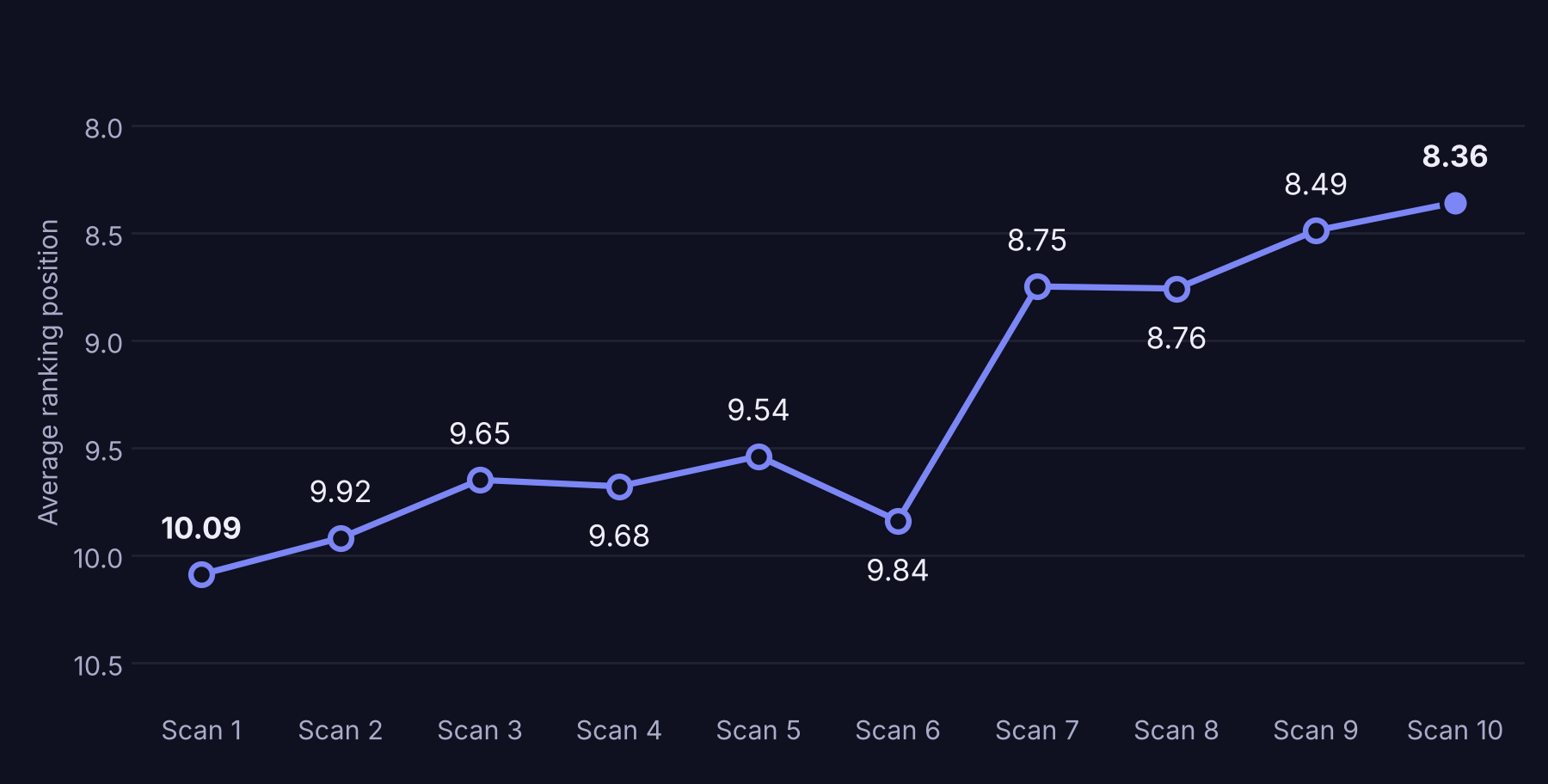
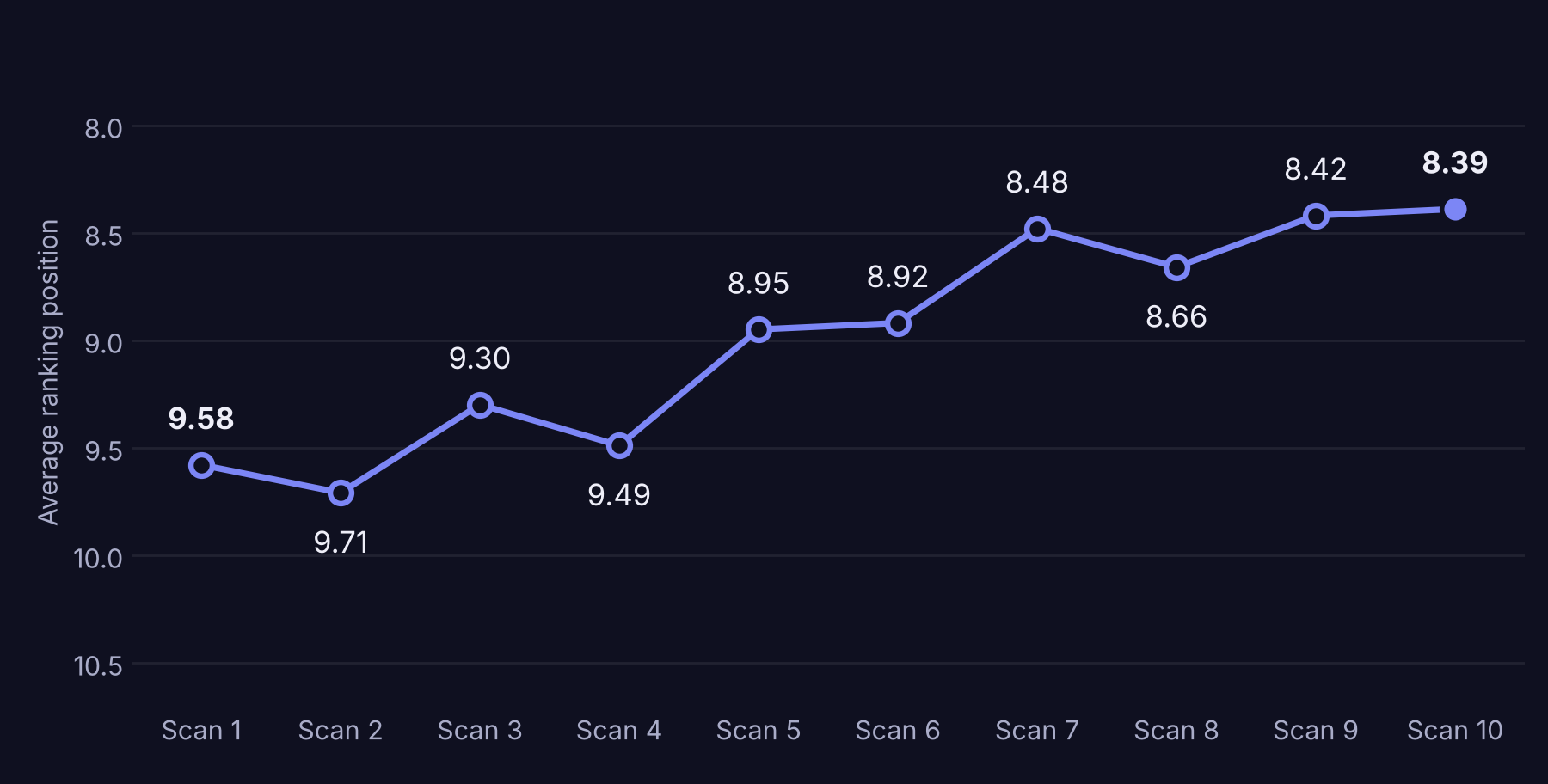
Average ranking position across the grid at each fortnightly scan. Lower numbers are better, so a rising line is an improvement.
The maps show the same story for the second term. In July the business was in the top 3 at three points. By November it was six, and positions had improved across most of the grid.
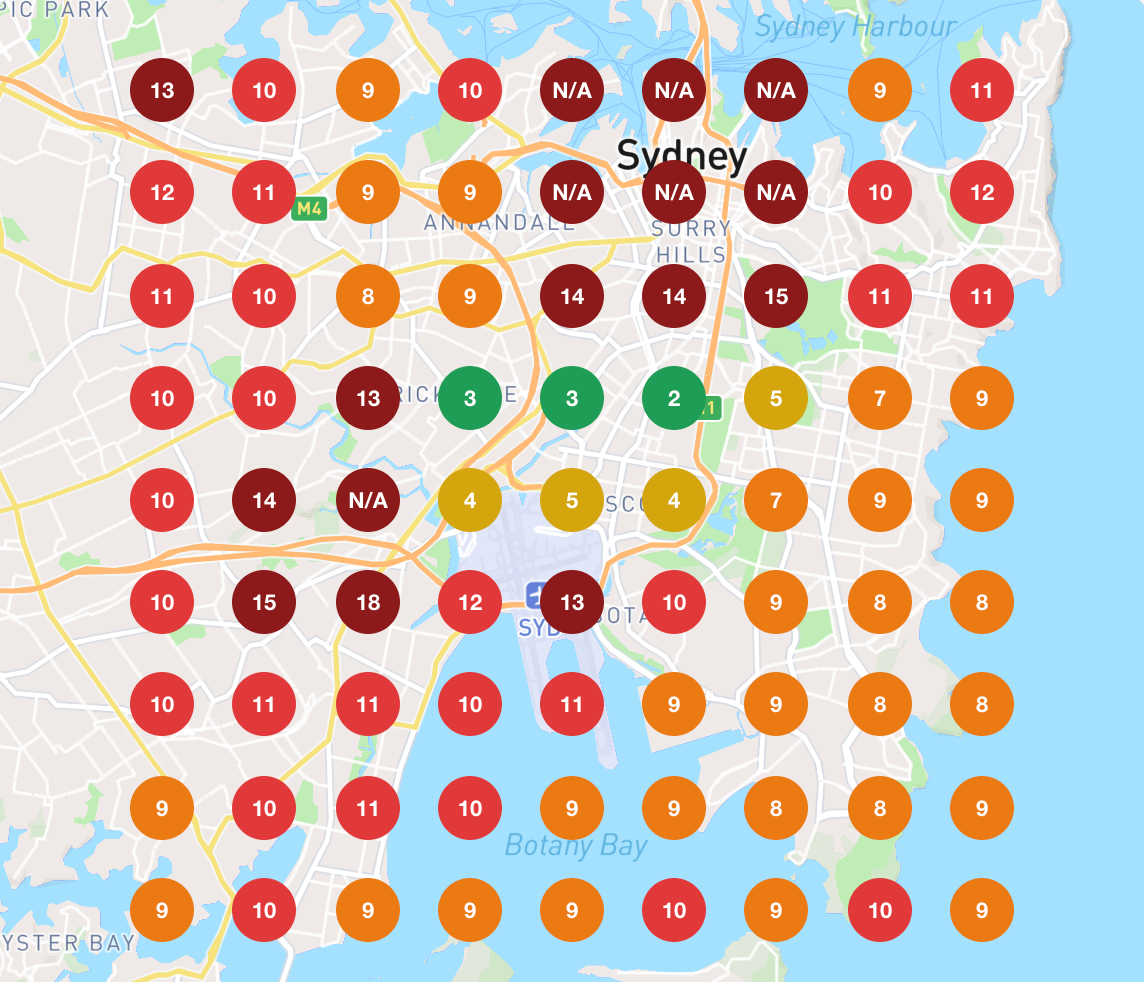
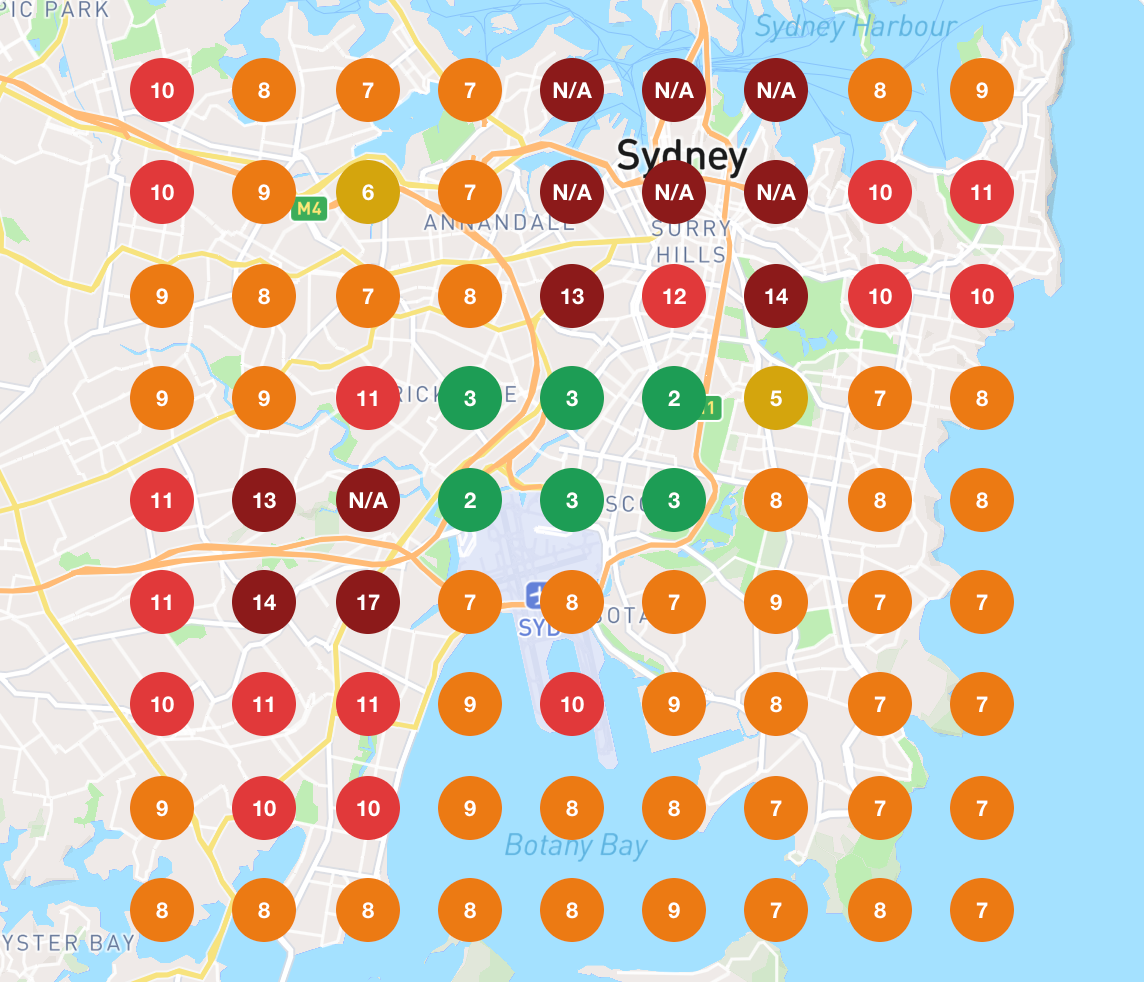
Each pin is one search point on a 9 × 9 grid, and the number is the business’s position there. Map data © Mapbox © OpenStreetMap.
That is what a hard Sydney keyword looks like: between one and two places gained in four months, a fraction of a place at a time, with the odd step back. No single fortnight looked like a win. The gain came from the same work repeated every cycle, which is why patience and consistency are the whole strategy for terms like these.
What to do, in order
Start with the things Google reads first, then work outwards from your own suburb.
- Check your primary category. It is the top-ranked factor in the Whitespark survey. Pick the category that matches the search you most want to win, and look at what the businesses already in the top 3 for that search have chosen.
- Fill in your services. Keywords in profile services was one of the biggest climbers in the 2026 edition, moving from 110th to 35th. In one Sydney account we manage, keyword groups with a matching service on the profile improved their position 2 to 8 times more than groups without one. That is a pattern in one account. We wrote about getting it right in the Google Business Profile services list.
- Show your address if customers can visit you there.
- Publish the hours you are really available.
- Ask for reviews every week. Recency is what both the research and customers respond to, so a steady trickle does more than a burst once a year.
- Win your own suburb first. Track and target searches that name your suburb and the ones next to it before you chase the city-wide terms.
- Make your website agree with your profile. The same name, address and phone number on both ranks 15th in the Whitespark survey, and content about the suburbs you serve ranks 18th.
- Measure on a grid. A single search from your office shows you the one place you are most likely to rank well.
Three things to leave alone: adding keywords to a business name you do not trade under, publishing hours you do not keep, and buying reviews. Each breaches Google’s guidelines.
How to check where you rank across Sydney
Search for your main service from three places: outside your premises, two suburbs away, and in the suburb you most want customers from. Use a phone on mobile data, signed out of Google. If the top 3 changes each time, you have seen the Sydney problem first hand.
That gives you three points. A grid scan gives you 81, with your position at every one of them. There is more on this in how to check your Google ranking in Australia.
If you would like us to run it, the free ranking audit maps where your business ranks across your area for the searches that matter to you, and comes with a 7-day trial.
Frequently asked questions
Sources: First Page Sage, Google click-through rates by ranking position, 2026; BrightLocal, consumer search behaviour study, 2026, Local Consumer Review Survey, 2026, and local AI visibility study, 2026; Australian Bureau of Statistics, Regional population 2024-25, released 2026; ABS business counts for 2023 published by .id; Google Business Profile Help, Tips to improve your local ranking on Google, read November 2026; Rankings.io, proximity data study, 2021; StatCounter, search engine market share Australia, October 2026; Whitespark, Local Search Ranking Factors, 2026 edition, and AI Overviews in local search case study, 2025; Sterling Sky and Places Scout, near me ranking study, 2025; Search Engine Roundtable, Google local ranking documentation update, July 2025; Google Australia, Ask Maps announcement, August 2026. Sydney ranking figures are Spotlight Local first-party measurements for one client on a 9 × 9 grid across a 259 km² tracked area, July to November 2026 (details anonymised).
Want our new guides highlighted for you in Google Search and AI Overviews? Add Spotlight Local as a preferred source.